



Every fashion founder knows the feeling. A collection sells faster than planned, one size disappears overnight, and the finance team is still trying to work out what last season really cost. The clothes are the glamorous part. The numbers behind them rarely are.
Fashion runs on short cycles, huge assortments, and constant change. That mix makes stock and cash harder to control than in most other retail categories. Let’s look at where the pressure comes from, and why many brands start exploring an ERP for fashion industry operations once spreadsheets stop keeping up.
One Style, Dozens of SKUs
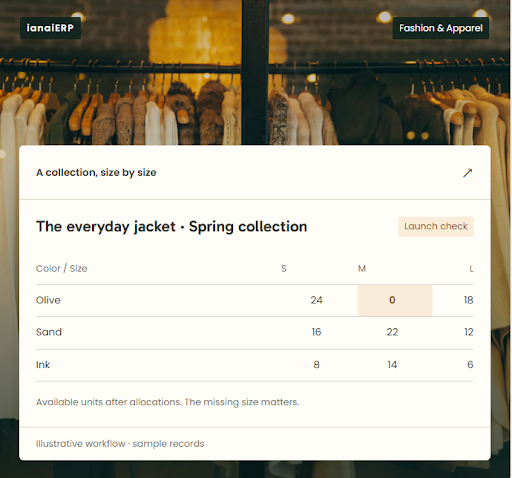
A single dress is never just one product. Add five colors, six sizes, and maybe two fits, and you have sixty SKUs from one design. Multiply that by a full collection, and you are tracking thousands of lines.
Creating those by hand takes days, and one typo can send the wrong size to a customer. Worse, the mistake spreads. Wrong counts lead to wrong reorders, which lead to wrong cost figures. Small data errors at the SKU level quietly turn into financial errors at the top.
Seasons Don’t Wait
Fashion has a hard calendar. Miss the window for a winter drop, and you can’t sell coats in March at full price. Buying decisions are made months ahead, often before you know what shoppers will actually want.
Order too much, and cash gets locked in stock that will end up on discount. Order too little and shelves sit empty while demand walks away. There is no comfortable middle, only educated guesses, and those guesses improve only when you can see past sales, current stock, and incoming orders in one place.
Stock Lives in Too Many Places
Most brands today sell through their own website, a few marketplaces, wholesale buyers, and sometimes physical stores. Each channel holds its own stock, and each updates at its own speed.
That is how overselling happens. A customer buys the last jacket online while the same jacket is promised to a wholesale client. Someone has to apologize, refund, and absorb the cost. On the flip side, you may have plenty of stock sitting in the wrong warehouse while another location runs dry. Without one shared view of what is available, you are either selling what you don’t have or hiding what you do.
Pricing and Markdowns Quietly Eat Margin
Fashion pricing is rarely simple. Wholesale tiers, volume discounts, retail prices, flash sales, and end-of-season markdowns all run at the same time. When these live in different files, mistakes are almost guaranteed.
A wrong wholesale price on a big order can cost more than a month of small errors elsewhere. Markdowns add another layer. Cut too early, and you give away margin. Cut too late, and you are stuck with dead stock. Returns make it messier, because returned items need to go back to the right location at the right value, not just back into a pile.
Cash Gets Trapped in Inventory
For most apparel brands, inventory is the biggest asset on the balance sheet and the biggest drain on cash. You pay suppliers upfront, wait for production, wait for delivery, and only then start earning.
During that gap, rent, salaries, and ads still need paying. Add preorders, cancellations, and changing demand, and cash flow forecasting turns into a moving target. Many owners find out they are short on cash only after a good sales month, because the money is sitting on a rack.
When Accounting and Operations Don’t Talk
Here is a problem that does not get enough attention. Many growing brands use accounting software for the books and a separate set of tools for stock, orders, and purchasing. Someone then copies numbers from one to the other.
That works for a while. Then volume grows, and month-end closing starts taking a week. Cost of goods sold looks off, and nobody can say why. A proper QuickBooks ERP integration can ease this by letting operational data flow into the accounts without manual re-entry. You keep the accounting tool your team already trusts, while stock movements, purchases, and sales feed it automatically. For a brand that is not ready to replace its books, it is often the most practical first step.
Bringing It Together
Fashion will always be unpredictable. Trends shift, weather changes buying habits, and a single viral post can empty a size run. You cannot remove that uncertainty, but you can stop it from becoming a financial surprise.
The brands that cope best tend to do a few simple things. They keep one source of truth for stock. They tie buying plans to real sales data. They set pricing rules once instead of fixing them order by order. And they make sure operations and finance are looking at the same numbers. None of this is flashy, but it is what separates a brand that grows steadily from one that is always catching up.
Today, modern cloud systems make this level of visibility accessible without enterprise-level complexity. Using an AI-driven platform such as ianaiERP lets growing brands connect inventory, stock planning, and daily workflows in one place, so they can scale smoothly instead of constantly firefighting.
FAQs
1. Why is inventory management harder in fashion than in other retail sectors?
Fashion products come in many colors, sizes, and fits, and collections change every season. This creates thousands of SKUs with short selling windows. Unsold stock loses value quickly, so planning mistakes cost more than they would in categories with steady, year-round demand.
2. How do markdowns affect a fashion brand’s profitability?
Markdowns lead to reduced margins on all the units sold. When a markdown is done too soon, the margin goes to waste, but when a markdown is done too late, there will be no sales and inventory that takes up valuable storage space and money.
3. What financial risks come with seasonal buying?
Brands usually make commitments for bulk purchases several months before they actually sell the products. In case of low demand, money is tied up in unsold inventory, whereas high demand means losses due to non-availability of stock. This poses challenges for cash management.
4. When should a fashion brand move beyond spreadsheets?
Normally, whenever the SKU count increases, there is the emergence of multiple sales channels, or there is a lengthy month-end close process. Whenever there is a discrepancy in stock numbers from different teams or pricing errors keep recurring, the use of spreadsheets may be causing more harm than good.